



Increasing Climate-induced Disasters: The Case for Urgent Climate Action in Sri Lanka
Author: Laxsumi Ananthakumaraswamy (MSc)
2023, 2024 and 2025 are among the top three warmest years on record, elucidating the urgent need for sustainable and equitable climate action.
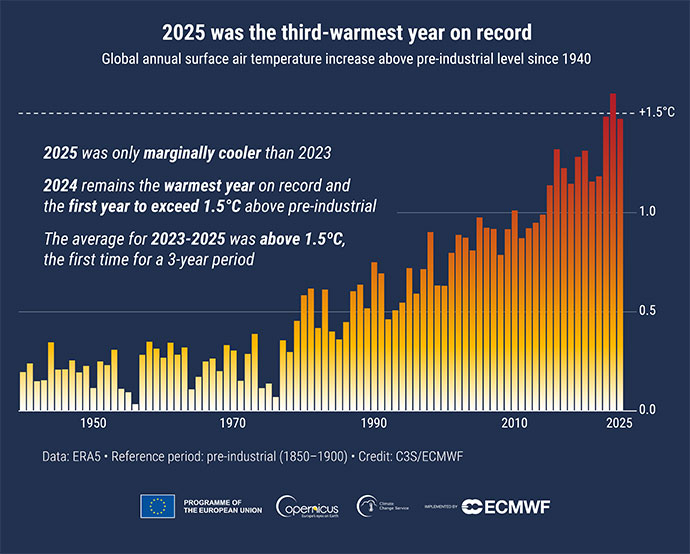
Figure 1- Global surface air temperature increase (ºC) above the average for the 1850–1900 designated pre-industrial reference period based on the ERA5 dataset, shown as annual averages since 1940. Credit: C3S/ECMWF.
The devastating impacts of climate change are being felt worldwide, leading to increasingly severe and frequent climate-induced natural disasters, including droughts, floods, hurricanes, heatwaves, and wildfires. In addition to these heightened hydrometeorological and climatological disasters, sea levels are rising. Globally, climate-related disasters have increased by 83% over the past four decades, rising from 3,656 events between 1980 and 1999 to 6,681 between 2000 and 2019.
Climate change threatens every aspect of society, the economy, the environment, and the fabric of humanity. The impacts of climate change are not felt equally around the world. Developing countries and Small Island Developing States (SIDS) are disproportionately affected. One of the root causes of this disparity is poverty. Developing countries and SIDS frequently lack the resources and finances to minimise the impacts of disasters and recover in their aftermath. Consequently, they face severe cascading effects when climate-induced disasters occur, commonly leading to the loss of human life, infrastructure damage, loss of livelihoods, socio-economic disruption, and displacement, perpetuating a cycle of poverty. Additionally, certain groups of people, including children, the elderly, people with disabilities, and women, experience pronounced suffering after catastrophic disasters due to intersecting forms of inequalities.
Sri Lanka’s Growing Vulnerability to Climate Change
Sri Lanka is one of the most vulnerable countries to the impacts of climate change. The Global Climate Risk Index (CRI) ranks countries by the economic and human toll of extreme weather events. In 2024, Sri Lanka ranked 52nd on the CRI. Increasing climate change will result in Sri Lanka experiencing more floods, droughts, and storm surges due to changing sea levels and average temperatures. Additionally, will experience increased extreme precipitation events causing riverine flooding, flash floods and landslides.
Climate change is expected to exacerbate food insecurity by reducing food and water availability, causing a decrease in agricultural yields. Agricultural productivity will be affected from the national level to the household level. The Building Resilience, Inclusive Growth and Holistic Transformation (BRIGHT) Survey found that 33% of households reported moderate or severe food insecurity in 2025. Therefore, climate adaptation policies that focus on enhancing agricultural resilience must be implemented.
Climate change poses major risks to development and increases the vulnerability of local communities to extreme weather events. Climate change is resulting in Sri Lanka experiencing more frequent extreme heat. Currently, the number of days surpassing 35 °C is 20 days per year, and this is set to surpass more than 100 days per year by 2090. Extreme heat causes a public health risk by affecting human health and diminishing living standards; outdoor labourers are particularly vulnerable, especially without efficient cooling systems. Extreme heat will be seen largely in Sri Lanka’s northern region.

Figure 2- Heat Risk by District under SSP3-7.0 Scenario in the Short Term (2020–2039) and Medium Term (2040–2059)
Climate change can have adverse impacts on Sri Lanka’s large tourism industry. Tourism directly contributes to 5% of national employment and an additional 11% indirectly. A significant majority of tourism occurs in coastal areas and, therefore, is vulnerable to an array of climate hazards: sea-level rise, associated increase in erosion, storm surges, riverine flooding, extreme heat, and extreme rainfall. A significant amount of capital needs to be invested in adaptation to help protect the tourism sector.
For instance, in November 2025, Sri Lanka faced one of its worst disasters as Cyclone Ditwah rampaged through the country, causing severe flooding and landslides, claiming more than 1000 lives, displacing 833,000 people, and destroying more than 25000 homes. The destruction of infrastructure, including hospitals, reduced accessibility to healthcare, while damaged agriculture exacerbated food insecurity. A third of the country lost running water and electricity, reducing access to safe drinking water. People living in rural regions and farmers were disproportionately affected by Cyclone Ditwah, as these communities were already facing the impacts of climate change and debt.
How can we build a climate-resilient future?
· Climate Finance— Addressing gaps in global climate finance is crucial for every country to implement effective adaptation and mitigation strategies. Developed countries must uphold the New Collective Quantified Goal of $300 billion annually by 2035. Funding will help accelerate climate action in developing countries, eradicate poverty and promote sustainable development.
· Climate Adaptation—Implementing sustainable context-specific adaptation can help alleviate the impacts of climate-induced disasters and build more resilient communities. Including vulnerable populations and marginalised voices in policy-making processes, particularly in research, is essential to creating equitable and sustainable adaptation strategies. This may involve community-based adaptation approaches and nature-based solutions.
· Climate Mitigation— Reducing greenhouse gas emissions can help reduce the risk of climate-related disasters. This can be achieved by transitioning to renewable energy sources, improving transportation through electrification, and protecting and restoring forests that capture carbon.
Sources
https://wmo.int/news/media-centre/wmo-confirms-2025-was-one-of-warmest-years-record
https://www.germanwatch.org/en/cri
https://srilanka.un.org/en/254230-fact-sheet-climate-impact-sri-lanka
https://weatheringrisk.org/sites/default/files/document/Sri_Lanka_Climate_Impact_Profile.pdf
https://climate.copernicus.eu/copernicus-2025-was-third-hottest-year-record
https://cafod.org.uk/news/emergencies-news/cyclone-ditwah-sri-lanka